Feature #43355
closed

Add pagination support for members and groups management views
Description
When assigning hundreds (or thousands) of users to a project or a group, the project settings page and the groups page have become very slow.
I added pagination to optimize performance. Page load times with 1000+ users dropped from over 5 seconds to around 1.5 seconds.
This feature is based on the stable 5.1 branch.
I added tests.
However, a double-check wouldn’t hurt.
Files
Related issues
 Updated by Takenori TAKAKI 3 months ago
- File 0001-members-pagination.patch 0001-members-pagination.patch added
- File 0002-groups-pagination.patch 0002-groups-pagination.patch added
Thank you for working on this.
The members and groups management pages really need pagination on large installations.
I rebased the change onto the current trunk (the attached patch is based on 5.1 and no longer applies cleanly) and split it into two commits — one for the project members list and one for the group users list. Apply 0001 first, then 0002.
Two notable differences from the original patch:
- Members with several roles. `Member.sorted` orders by `roles.position` and therefore joins the roles table, so a member with N roles produces N rows. Applying `LIMIT`/`OFFSET` to that scope paginates join rows rather than members, which can list a member twice or skip one. In the members commit I collect the sorted, de-duplicated member ids first (keeping the lowest role position) and then load only that page, so pagination counts members. The group users list is ordered by name (no such join), so a plain `limit`/`offset` is fine there.
- No controller concern. I kept the pagination in helpers (`paginate_members` / `paginate_group_users`), next to the existing `render_principals_for_new_members` / `render_principals_for_new_group_users`, instead of adding an `app/controllers/concerns` module (Redmine has no controller concerns yet). The partials are rendered from several controllers, so a helper keeps it in one place without duplicating across actions.
Like the original, a dedicated page parameter (`members_page` / `users_page`) is used so it doesn't clash with the `page` used by the add-member / add-user modals.
Tests pass on the current trunk.
Updated by Takenori TAKAKI about 1 month ago
- File 0001-Add-pagination-to-the-project-members-management-list.patch 0001-Add-pagination-to-the-project-members-management-list.patch added
- File 0002-Add-pagination-to-the-group-users-management-list.patch 0002-Add-pagination-to-the-group-users-management-list.patch added
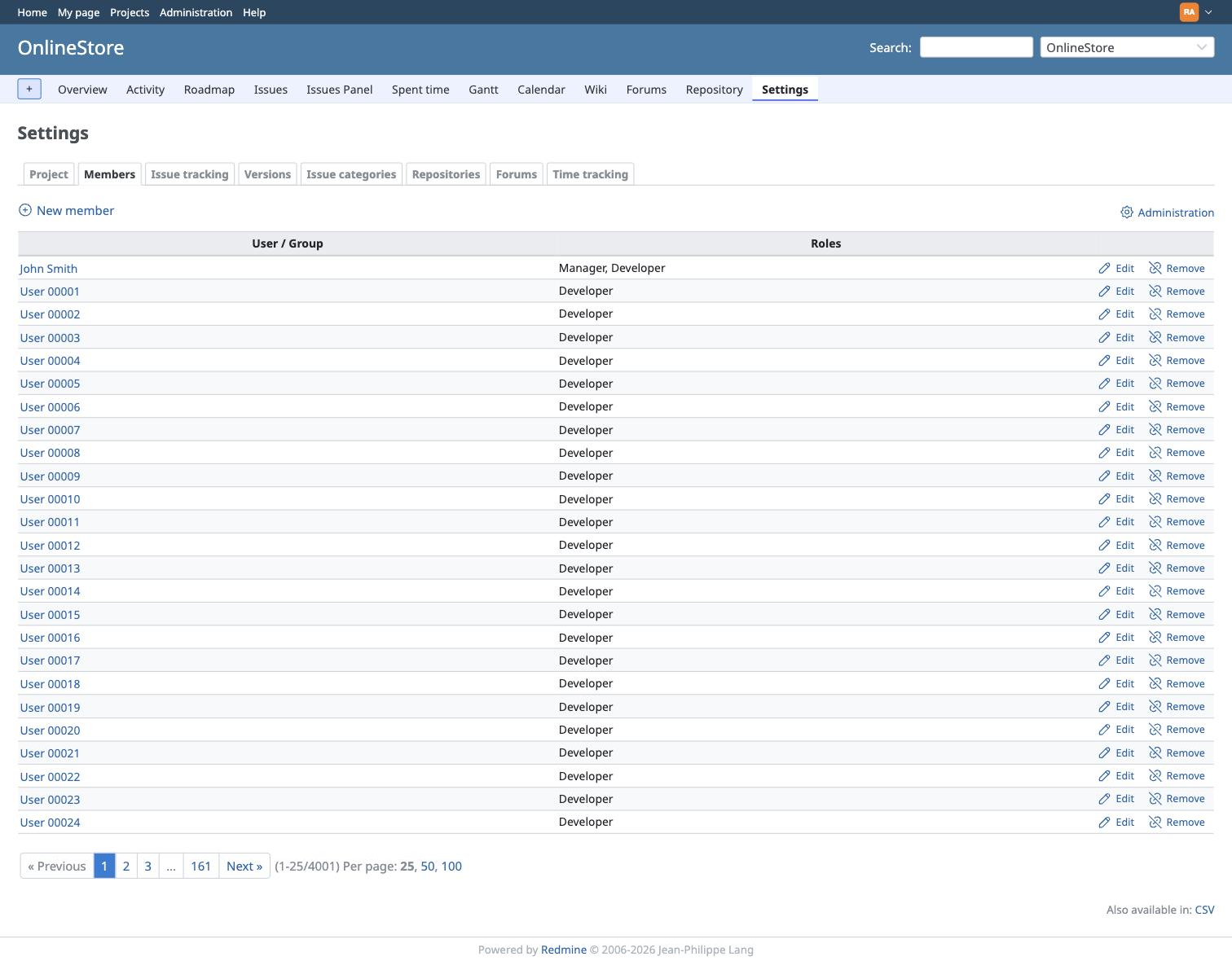
- File 20260909-en-01-project-members-list-pagination.png 20260909-en-01-project-members-list-pagination.png added
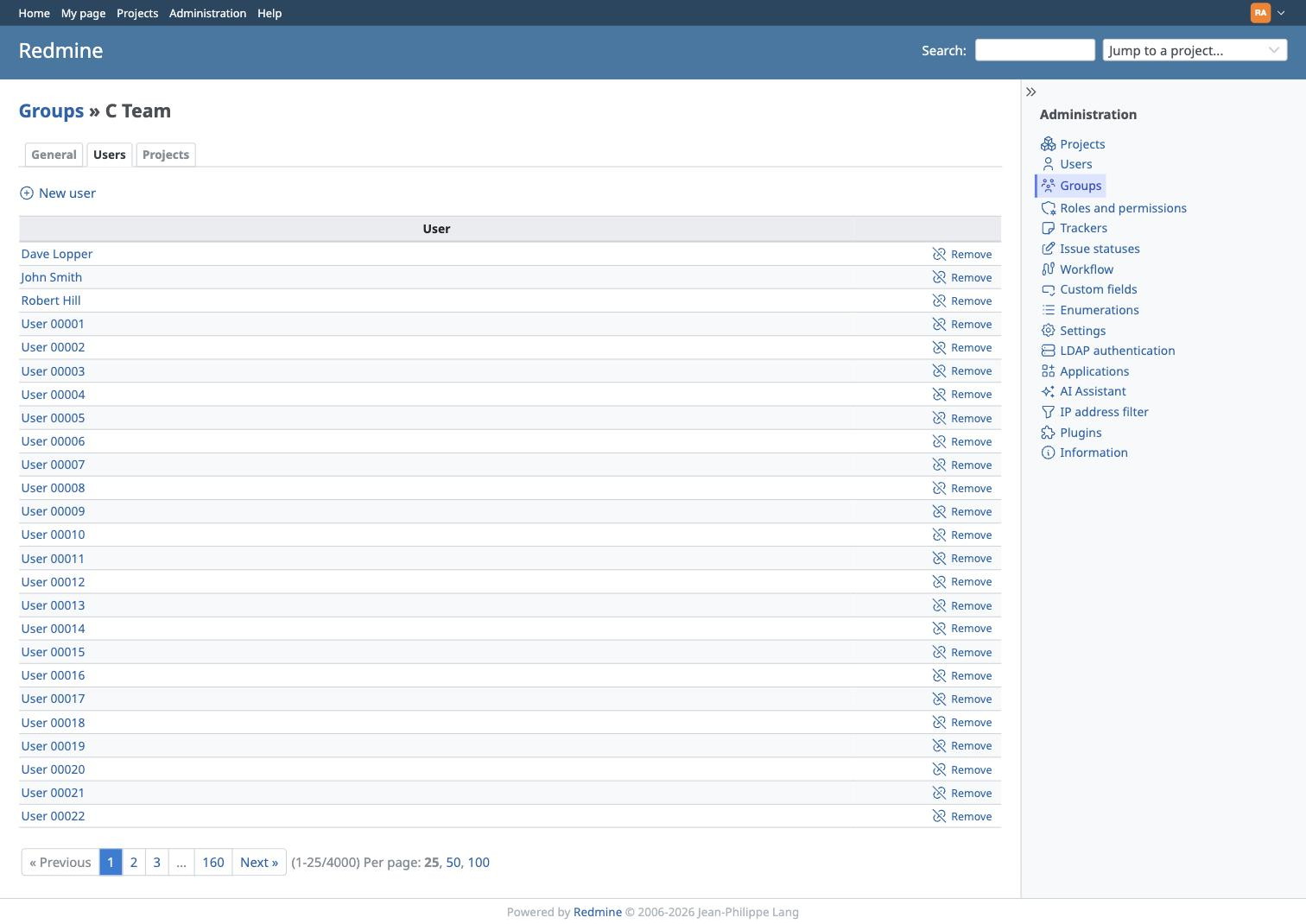
- File 20260909-en-02-group-users-list-pagination.png 20260909-en-02-group-users-list-pagination.png added
I found a few things to improve in the patches I attached in note-1, so here is an
updated pair, rebased onto the current trunk. Apply 0001 (project members list)
first, then 0002 (group users list).
Improvements over the previous patches:
- Fixed the list showing "No data" when an out-of-range page is requested.
- Added spacing between the list and the pagination controls, matching the other
list screens. - Trimmed the code comments to the single non-obvious point.
Measured on the project members settings page of a project with ~4000 members
(development, SQLite, warm):
- Members tab: ~4.9 s -> ~0.33 s
- Members list partial alone: ~4.5 s -> ~0.04 s
- 25 member rows loaded per page, no N+1.
These are development-mode figures; production is faster. Screenshots attached.
| Project members list (Settings -> Members) | Group users list (Groups -> Users) |
|---|---|
 |
 |
 Updated by Katsuya HIDAKA about 1 month ago
Looks good to me.
I confirmed with a project that has about 4,000 members that the patch improves performance and that pagination works as expected on Chrome, Safari, and Firefox.
I also confirmed that all tests pass.
 Updated by Marius BĂLTEANU about 1 month ago
- Assignee set to Marius BĂLTEANU
- Target version set to 7.1.0
Updated by Marius BĂLTEANU about 1 month ago
- Status changed from New to Resolved
- Resolution set to Fixed
Both patches committed, thanks for the nice work!
Updated by Marius BĂLTEANU about 1 month ago
- Status changed from Resolved to Closed
Updated by Marius BĂLTEANU about 1 month ago
- Related to Feature #44458: Filter project members by name, role and status in project settings added
Updated by Marius BĂLTEANU about 1 month ago
In #44458, I've added a patch that allows to filter project members by name and role in project settings.